By George Friedman
STRATFOR does not normally involve itself in domestic American politics. Our focus is on international affairs, and American politics, like politics everywhere, is a passionate business. The vilification from all sides that follows any mention we make of American politics is both inevitable and unpleasant. Nevertheless, it’s our job to chronicle the unfolding of the international system, and the fact that the United States is moving deeply into an election cycle will affect American international behavior and therefore the international system.
The United States remains the center of gravity of the international system. The sheer size of its economy (regardless of its growth rate) and the power of its military (regardless of its current problems) make the United States unique. Even more important, no single leader of the world is as significant, for good or bad, as the American president. That makes the American presidency, in its broadest sense, a matter that cannot be ignored in studying the international system.
The American system was designed to be a phased process. By separating the selection of the legislature from the selection of the president, the founders created a system that did not allow for sudden shifts in personnel. Unlike parliamentary systems, in which the legislature and the leadership are intimately linked, the institutional and temporal uncoupling of the system in the United States was intended to control the passing passions by leaving about two-thirds of the U.S. Senate unchanged even in a presidential election year, which always coincides with the election of the House of Representatives. Coupled with senatorial rules, this makes it difficult for the president to govern on domestic affairs. Changes in the ideological tenor of the system are years in coming, and when they come they stay a long time. Mostly, however, the system is in gridlock. Thomas Jefferson said that a government that governs least is the best. The United States has a vast government that rests on a system in which significant change is not impossible but which demands a level of consensus over a period of time that rarely exists.
This is particularly true in domestic politics, where the complexity is compounded by the uncertainty of the legislative branch. Consider that the healthcare legislation passed through major compromise is still in doubt, pending court rulings that thus far have been contradictory. All of this would have delighted the founders if not the constantly trapped presidents, who frequently shrug off their limits in the domestic arena in favor of action in the international realm, where their freedom to maneuver is much greater, as the founders intended.
The Burden of the Past
The point of this is that all U.S. presidents live within the framework in which Barack Obama is now operating. First, no president begins with a clean slate. All begin with the unfinished work of the prior administration. Thus, George W. Bush began his presidency with an al Qaeda whose planning and implementation for 9/11 was already well under way. Some of the al Qaeda operatives who would die in the attack were already in the country. So, like all of his predecessors, Obama assumed the presidency with his agenda already laid out.
Obama had a unique set of problems. The first was his agenda, which focused on ending the Iraq war and reversing social policies in place since Ronald Reagan became president in 1981. By the time Obama entered office, the process of withdrawal from Iraq was under way, which gave him the option of shifting the terminal date. The historic reversal that he wanted to execute, starting with healthcare reform, confronted the realities of September 2008 and the American financial crisis. His Iraq policy was in place by Inauguration Day while his social programs were colliding with the financial crisis.
Showing posts with label Barack Obama. Show all posts
Showing posts with label Barack Obama. Show all posts
Tuesday, September 20, 2011


Saturday, September 4, 2010
"Rethinking American Options on Iran is republished with permission of STRATFOR." Read more: Rethinking American Options on Iran | STRATFOR
By George Friedman
Public discussion of potential attacks on Iran’s nuclear development sites is surging again. This has happened before. On several occasions, leaks about potential airstrikes have created an atmosphere of impending war. These leaks normally coincided with diplomatic initiatives and were designed to intimidate the Iranians and facilitate a settlement favorable to the United States and Israel. These initiatives have failed in the past. It is therefore reasonable to associate the current avalanche of reports with the imposition of sanctions and view it as an attempt to increase the pressure on Iran and either force a policy shift or take advantage of divisions within the regime.
My first instinct is to dismiss the war talk as simply another round of psychological warfare against Iran, this time originating with Israel. Most of the reports indicate that Israel is on the verge of attacking Iran. From a psychological-warfare standpoint, this sets up the good-cop/bad-cop routine. The Israelis play the mad dog barely restrained by the more sober Americans, who urge the Iranians through intermediaries to make concessions and head off a war. As I said, we have been here before several times, and this hasn’t worked.
The worst sin of intelligence is complacency, the belief that simply because something has happened (or has not happened) several times before it is not going to happen this time. But each episode must be considered carefully in its own light and preconceptions from previous episodes must be banished. Indeed, the previous episodes might well have been intended to lull the Iranians into complacency themselves. Paradoxically, the very existence of another round of war talk could be intended to convince the Iranians that war is distant while covert war preparations take place. An attack may be in the offing, but the public displays neither confirm nor deny that possibility.
The Evolving Iranian Assessment
STRATFOR has gone through three phases in its evaluation of the possibility of war. The first, which was in place until July 2009, held that while Iran was working toward a nuclear weapon, its progress could not be judged by its accumulation of enriched uranium. While that would give you an underground explosion, the creation of a weapon required sophisticated technologies for ruggedizing and miniaturizing the device, along with a very reliable delivery system. In our view, Iran might be nearing a testable device but it was far from a deliverable weapon. Therefore, we dismissed war talk and argued that there was no meaningful pressure for an attack on Iran.
We modified this view somewhat in July 2009, after the Iranian elections and the demonstrations. While we dismissed the significance of the demonstrations, we noted close collaboration developing between Russia and Iran. That meant there could be no effective sanctions against Iran, so stalling for time in order for sanctions to work had no value. Therefore, the possibility of a strike increased.
But then Russian support stalled as well, and we turned back to our analysis, adding to it an evaluation of potential Iranian responses to any air attack. We noted three potential counters: activating Shiite militant groups (most notably Hezbollah), creating chaos in Iraq and blocking the Strait of Hormuz, through which 45 percent of global oil exports travel. Of the three Iranian counters, the last was the real “nuclear option.” Interfering with the supply of oil from the Persian Gulf would raise oil prices stunningly and would certainly abort the tepid global economic recovery. Iran would have the option of plunging the world into a global recession or worse.
There has been debate over whether Iran would choose to do the latter or whether the U.S. Navy could rapidly clear mines. It is hard to imagine how an Iranian government could survive air attacks without countering them in some way. It is also a painful lesson of history that the confidence of any military force cannot be a guide to its performance. At the very least, there is a possibility that the Iranians could block the Strait of Hormuz, and that means the possibility of devastating global economic consequences. That is a massive risk for the United States to take, against an unknown probability of successful Iranian action. In our mind, it was not a risk that the United States could take, especially when added to the other Iranian counters. Therefore, we did not think the United States would strike.
Certainly, we did not believe that the Israelis would strike Iran alone. First, the Israelis are much less likely to succeed than the Americans would be, given the size of their force and their distance from Iran (not to mention the fact that they would have to traverse either Turkish, Iraqi or Saudi airspace). More important, Israel lacks the ability to mitigate any consequences. Any Israeli attack would have to be coordinated with the United States so that the United States could alert and deploy its counter-mine, anti-submarine and missile-suppression assets. For Israel to act without giving the United States time to mitigate the Hormuz option would put Israel in the position of triggering a global economic crisis. The political consequences of that would not be manageable by Israel. Therefore, we found an Israeli strike against Iran without U.S. involvement difficult to imagine.
The Current Evaluation
Our current view is that the accumulation of enough enriched uranium to build a weapon does not mean that the Iranians are anywhere close to having a weapon. Moreover, the risks inherent in an airstrike on its nuclear facilities outstrip the benefits (and even that assumes that the entire nuclear industry is destroyed in one fell swoop — an unsure outcome at best). It also assumes the absence of other necessary technologies. Assumptions of U.S. prowess against mines might be faulty, and so, too, could my assumption about weapon development. The calculus becomes murky, and one would expect all governments involved to be waffling.
Public discussion of potential attacks on Iran’s nuclear development sites is surging again. This has happened before. On several occasions, leaks about potential airstrikes have created an atmosphere of impending war. These leaks normally coincided with diplomatic initiatives and were designed to intimidate the Iranians and facilitate a settlement favorable to the United States and Israel. These initiatives have failed in the past. It is therefore reasonable to associate the current avalanche of reports with the imposition of sanctions and view it as an attempt to increase the pressure on Iran and either force a policy shift or take advantage of divisions within the regime.
My first instinct is to dismiss the war talk as simply another round of psychological warfare against Iran, this time originating with Israel. Most of the reports indicate that Israel is on the verge of attacking Iran. From a psychological-warfare standpoint, this sets up the good-cop/bad-cop routine. The Israelis play the mad dog barely restrained by the more sober Americans, who urge the Iranians through intermediaries to make concessions and head off a war. As I said, we have been here before several times, and this hasn’t worked.
The worst sin of intelligence is complacency, the belief that simply because something has happened (or has not happened) several times before it is not going to happen this time. But each episode must be considered carefully in its own light and preconceptions from previous episodes must be banished. Indeed, the previous episodes might well have been intended to lull the Iranians into complacency themselves. Paradoxically, the very existence of another round of war talk could be intended to convince the Iranians that war is distant while covert war preparations take place. An attack may be in the offing, but the public displays neither confirm nor deny that possibility.
The Evolving Iranian Assessment
STRATFOR has gone through three phases in its evaluation of the possibility of war. The first, which was in place until July 2009, held that while Iran was working toward a nuclear weapon, its progress could not be judged by its accumulation of enriched uranium. While that would give you an underground explosion, the creation of a weapon required sophisticated technologies for ruggedizing and miniaturizing the device, along with a very reliable delivery system. In our view, Iran might be nearing a testable device but it was far from a deliverable weapon. Therefore, we dismissed war talk and argued that there was no meaningful pressure for an attack on Iran.
We modified this view somewhat in July 2009, after the Iranian elections and the demonstrations. While we dismissed the significance of the demonstrations, we noted close collaboration developing between Russia and Iran. That meant there could be no effective sanctions against Iran, so stalling for time in order for sanctions to work had no value. Therefore, the possibility of a strike increased.
But then Russian support stalled as well, and we turned back to our analysis, adding to it an evaluation of potential Iranian responses to any air attack. We noted three potential counters: activating Shiite militant groups (most notably Hezbollah), creating chaos in Iraq and blocking the Strait of Hormuz, through which 45 percent of global oil exports travel. Of the three Iranian counters, the last was the real “nuclear option.” Interfering with the supply of oil from the Persian Gulf would raise oil prices stunningly and would certainly abort the tepid global economic recovery. Iran would have the option of plunging the world into a global recession or worse.
There has been debate over whether Iran would choose to do the latter or whether the U.S. Navy could rapidly clear mines. It is hard to imagine how an Iranian government could survive air attacks without countering them in some way. It is also a painful lesson of history that the confidence of any military force cannot be a guide to its performance. At the very least, there is a possibility that the Iranians could block the Strait of Hormuz, and that means the possibility of devastating global economic consequences. That is a massive risk for the United States to take, against an unknown probability of successful Iranian action. In our mind, it was not a risk that the United States could take, especially when added to the other Iranian counters. Therefore, we did not think the United States would strike.
Certainly, we did not believe that the Israelis would strike Iran alone. First, the Israelis are much less likely to succeed than the Americans would be, given the size of their force and their distance from Iran (not to mention the fact that they would have to traverse either Turkish, Iraqi or Saudi airspace). More important, Israel lacks the ability to mitigate any consequences. Any Israeli attack would have to be coordinated with the United States so that the United States could alert and deploy its counter-mine, anti-submarine and missile-suppression assets. For Israel to act without giving the United States time to mitigate the Hormuz option would put Israel in the position of triggering a global economic crisis. The political consequences of that would not be manageable by Israel. Therefore, we found an Israeli strike against Iran without U.S. involvement difficult to imagine.
The Current Evaluation
Our current view is that the accumulation of enough enriched uranium to build a weapon does not mean that the Iranians are anywhere close to having a weapon. Moreover, the risks inherent in an airstrike on its nuclear facilities outstrip the benefits (and even that assumes that the entire nuclear industry is destroyed in one fell swoop — an unsure outcome at best). It also assumes the absence of other necessary technologies. Assumptions of U.S. prowess against mines might be faulty, and so, too, could my assumption about weapon development. The calculus becomes murky, and one would expect all governments involved to be waffling.
Thursday, September 17, 2009
Let's Lose the "Race Card"
Having acknowledged that, it's time for Dems and progressives to put aside the "race card". While it is certainly a legitimate criticism of the attitudes and tactics of many on the right wing fringe, focusing our attention on this issue is a distraction that our opponents invite and fully use to their advantage to divert attention from what should be the real focus of our debate--our fragile and struggling economic system that continues to be significantly impacted by the exponential rise in health care costs and a broken healthcare system that fails to address the needs of all of our citizens.
It's time to put the "race card" back in the deck and play the "smart card". The facts speak for themselves and they fully support the position espoused by President Obama and his supporters. The current healthcare system is broke. Millions of our fellow citizens lack insurance and access to adequate health care and those of us with benefits should be mindful, particularly in the current economic climate, that we all face the risk of falling into that category. Thousands of Americans (including those with health insurance) each day file for bankruptcy precipitated by their inability to pay their medical bills. The impact of rising health care cost continues to impact the ability of corporate America to compete in a global economy and is crippling the small business sector. Many on the right and the center argue that we're moving too fast and it's foolhardy to tackle this issue at the same time that we're attempting to revive a fragile economy without fully comprehending that true health care reform is vital to the long term viability of our economy.
There exists in this nation an intelligent, rational, responsible and fair-minded majority that is ready and willing to support reasonable solutions to the serious problems we face. It's time to reject racism and the use of the "race card" and get on with a serious debate of how to solve the serious problems our nation faces.
![Reblog this post [with Zemanta]](http://img.zemanta.com/reblog_e.png?x-id=15c73186-abed-47cf-a23c-a5fc06cc4264)
Sunday, August 9, 2009
HEALTH CARE REFORM--The Republican Playbook

First of all, let's consider the facts.....The United States spends over $1.9 trillion annually on healthcare expenses, more than any other industrialized country. This figure includes costs to our government, the private sector, and individuals. Researchers at Johns Hopkins Medical School have estimated the United States spends 44 percent more per capita than Switzerland, the country with the second highest expenditures, and 134 percent more than the median for members of the Organization for Economic Cooperation and Development (whose member states include all of the European nations, Mexico, Japan and S. Korea). And U.S. economic woes have only increased the burden of health care costs on individuals and businesses. The United States spent 16 percent of its GDP in 2007 on health care, also higher than any other developed nation. And the nonpartisan Congressional Budget Office (CBO) estimates that number will rise to 25 percent by 2025 without changes to federal law. In November 2008 Kaiser Foundation reported health premiums for workers have risen 114 percent in the last decade. And the U.S. Chamber of Commerce has noted that, at 12 percent, health care is the most expensive benefit paid by U.S. employers.
The Republican spin machine has been working fast and furious during the recent presidential campaign and since to avoid and obscure the real truth about the very serious issue of heath care in our country. Sadly, the truth is that tens of millions of our fellow citizens are uninsured, not because they have opted out, but rather because they can not afford it. And the United States--the sole remaining superpower also has the dubious distinction of being the only developed country remaining in the world community where health care is a privilege and not a right of citizenship. And the ever-rising costs of health care is a concern to small business owners. Small Business Majority, according to its website, sets out its goal as, “solving the single-biggest problem facing America’s 27 million small businesses: affordable and accessible health care.” Its chief executive, John Arensmeyer, says, “We’re trying to make sure that policymakers understand how critical getting health care reform is for small business and how our health care crisis is killing small business.” Even for those of us that have health care insurance, the reality is that we are only a heartbeat away from bankruptcy if we experience a serious accident or major medical illness or lose our jobs.
And the tactics of the Republican and right wing conservative nay-sayers can be summed up neatly--delay, distract, distort, demagogue and disrupt.
Sunday, August 2, 2009
The Politics of Fear, Hate and Division
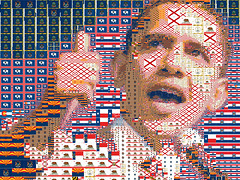 Image by tsevis via Flickr
So, at this crucial juncture, the hate and fear mongers at Fox News and conservative talk radio show hosts have doubled down on their efforts to tear down this perceived threat to the status quo by playing the race card. When you cut to the chase, Sean Hannity stating that President Obama is not one of us, Michelle Malkin referring to Obama's "cronies of color" and the birthers (and the complicit Republicans who decline to repudiate their viewpoint) ultimately appeal to our baser instincts--the fear and distrust in people that has always been at the very core of that lingering stain on our national character--racism.
There are legitimate differences of opinion and philosophy on the solutions to the serious problems our nation and world faces. Let's debate them civilly and earnestly--keeping our citizens' and country's best interests always in mind. The time has come to repudiate the politics of fear, division and hatred promulgated by Inanity, Limbaugh, Beck, Malkin, Coulter and their ilk and move forward in a truly bipartisan effort to meet the challenges we face. Our future and the future of generations to come hangs in the balance!
![Reblog this post [with Zemanta]](http://img.zemanta.com/reblog_e.png?x-id=5b694e68-3fb1-473b-99f6-0a82d169cc98)
Sunday, September 7, 2008
Reflections on the Past Week...The New Palin-McCain Double-Talk Express, etc.
Once again I honor Senator's McCain's military service and the courage he displayed as a POW in Vietnam. Certainly worthy of an inspirational movie or naming streets, bridges or buildings for him or we could even construct a McCain memorial in the appropriate setting. But it does not uniquely qualify him to hold the office of President of the United States. And his biography from that life experience forward is certainly not an untarnished testimony to honor and courage. There is the failed marriage and his involvement in the Keating 5 scandal. He developed a reputation as a maverick over the years, but his words and actions since his failed bid for the Republican nomination for President in 2000 reflect either a change in his core values and principles or an unmasking of an underlying cynicism and political ambition that the country was not aware of. Little wonder that we recently witnessed his angry refusal of a reporter's request to define "honor". McCain "the maverick" might have shown the courage he did as a freshman congressman when he opposed Reagan's disastrous deployment of our marines to Lebanon and spoken out against the infinitely more foolhardy decision of Bush and the neo-cons to manipulate the country into the ruinous Iraq conflict. He would not have voted with Bush and his peers 90% of the time over the past 8 yrs and so easily reversed his positions on tax cuts for the rich, torture, immigration and a host of other critical issues. McCain "the maverick" would have chosen Joe Lieberman or Tom Ridge as his running mate. And even though I do not share many of their views, I could have felt reasonably assured that they had the seasoning and judgment to safely be a heartbeat away from the Presidency. He would not have courted Jerry Falwell and Pat Robertson or more recently sought out the support of John Hagee and Rod Parsley and he surely would not have allowed himself to be forced into the choice of a ultra-conservative neophyte as his running mate by a social conservative cabal. The nomination of Gov Palin as VP for the Republican Party--a "pit bull with lip stick" as she so aptly described herself. She delivered the offensively sarcastic and condescending lines they wrote for her with such relish. Nothing out of character there if you've had the opportunity to review her record as a politician and the calculating, ruthless approach she has taken to furthering her career. And the smoothness with which she misrepresented her record and belittled Senator Obama's life story and accomplishments--she effectively energized the Republican base as we all sat and watched the final transformation of the McCain Straight Talk Express into the Palin-McCain Double Talk Express. And now the right wing pundits and hate-mongers scathingly attack the media for their hurried attempts to vet this little-known, political neophyte with the potential of being elected in less than eight weeks to an office which would place her a heartbeat away from the Presidency . I'll close for now by recommending to you the excellent commentary of Jon Stewart of the Daily Show on the hypocrisy so evident in their protestations--http://www.thedailyshow.com/video/index.jhtml?videoId=184086&title=sarah-palin-gender-card
Tuesday, September 2, 2008
John McHurricane and the New and Improved Republican Maverick Brand
Thinkin' there is fertile ground (manure-rich) for a hot, new action figure or maybe a new weed and feed product or would a weed stimulant be more apropos. Gotta love the political theater. McCain and his new VP pick jet down to the Gulf Coast in advance of the storm. The Republicans call for a political cease-fire (which didn't last long) and the nation's prayers and compassion. There was talk of McCain delivering his acceptance speech via satellite from the hurricane-ravaged Gulf Coast. But wait a second ...what does McCain's post-Katrina words and actions tell us about where he really stands and who he and President Bush and his Republican peers really care about. In the aftermath of Hurricane Katrina John McCain pledged to "do all that is necessary to fund essential relief and recovery efforts and help those in need". And did he "walk the talk"? Well, no, actually he sided with President Bush and the Republicans to quash the following legislative initiatives: S Amdt 1679 aimed at providing financial relief for victims: S Amdt 2356 aimed at the provision of emergency health care for survivors and S Amdt 2602 which would have provided tax benefits for affected areas. Alas, I don't think there's going to be much of a market for this action figure after all. We can tolerate flawed superheroes, but who needs one as out-of-touch and cynical as this one.
Sunday, January 27, 2008
Senator Barack Obama--When Poetry Becomes Prose
Throughout the campaign Senator Obama has been falsely charged of lacking a record of substantive action. Check out this post by Jonathan Cohn on TNR Blogs on 1/21/08:
From 1997 to 2004, as a member of the Illinois Senate, Obama advocated several proposals to make medical care more accessible--culminating, three years ago, in a bill designed to force the creation of a universal coverage system for Illinois. And, while none of these efforts come even close in scale to what he's promised to try in Washington, they do provide a window into the governing style he would pursue there.
Time after time, Obama brought adversaries into the process early, heard out their concerns, then fashioned compromises many of them ultimately supported. In other words, he used the very strategy he's been describing on the campaign trail--the one giving people like me such angst. And yet, if you talk to liberals in Springfield, the ones who've spent decades fighting for universal health care, you don't hear a lot of disappointment with him. As far as they are concerned, Obama's signature inclusiveness was always a means to an end--a way to push the limits of reform rather than accept them. And, they say, it worked.
In 2002, when Democrats won back control of the Senate, Obama became chairman of the Health and Human Services Committee. And it was from that perch that he adopted his other noteworthy health care cause, a measure called the Health Care Justice Act. The brainchild of grassroots activists tired of fighting losing battles to create a single-payer system for Illinois, the act, as originally proposed, would have created a task force, empowered it to develop a universal coverage plan, and then forced the legislature to vote on that plan. Predictably, it aroused the ire of insurers and other business interests, who, by all accounts, lobbied to derail the effort. "They--the insurers--pushed [Obama] really hard," says Jim Duffett, executive director of the Campaign for Better Health Care, the group championing the plan. "They also tried to use other people to push him really hard."
Publicly, Obama used hearings to rally voter support for universal coverage. Inside the statehouse, he pursued a two-track strategy. He made common cause with doctors and hospitals, two groups that had become more sympathetic to universal coverage because of the financial burdens charity care placed on them. This gave cover to moderates who wanted to support the bill, while increasing pressure on the insurers to fall in line. At the same time, Obama carried on discussions with the insurance and business lobbyists directly, eventually granting them two key concessions: He altered the makeup of the task force to make it more industryfriendly and dropped the provision requiring a vote from the next year's General Assembly. "We had significant concerns and looked to Senator Obama, who is an extremely bright and accessible individual," Phil Lackman, who represents the Professional Independent Insurance Agents of Illinois, told me. "My experience is that he is willing to listen to anybody willing to talk to him."
It's those kinds of statements that lead to stories, like one that The Boston Globe published in the fall, noting that "Obama's own experience in lawmaking involved dealings with the kinds of lobbyists and special interests he now demonizes on the campaign trail." But, whatever the contrast with Obama's campaign rhetoric, reformers in Springfield say the concessions worked out just fine. As it turned out, binding a future Assembly to vote on a measure was probably unconstitutional anyway. And the presence of insurance representatives on the task force may have actually bestowed it with additional legitimacy. Although those members would end up filing a dissent to the task force's final report--which was issued after Obama had moved on to the U.S. Senate--press attention focused on the majority recommendation. And that recommendation was just what many advocates hoped (and opponents feared) it would be: a comprehensive plan for universal coverage, financed and overseen by the state government. "He didn't back down," says Duffett. "There was no mandate [on the next Assembly to vote], but that was a constitutional issue. ... We got everything else we wanted."
Duffett's quote is important because he is among the state's most prominent and committed advocates on behalf of universal health care. (For the wonks out there, he's the Illinois equivalent of Ron Pollack.) If Obama were in the pocket of health care lobbyists, he'd be the first guy to complain. But Duffett has only good things to say about Obama. Very good things, as a matter of fact.
Caroline Kennedy endorses Barack Obama for President
Caroline Kennedy endorses Barack Obama for President in the New York Times...
A President Like My Father
OVER the years, I’ve been deeply moved by the people who’ve told me they wished they could feel inspired and hopeful about America the way people did when my father was president. This sense is even more profound today. That is why I am supporting a presidential candidate in the Democratic primaries, Barack Obama.
My reasons are patriotic, political and personal, and the three are intertwined. All my life, people have told me that my father changed their lives, that they got involved in public service or politics because he asked them to. And the generation he inspired has passed that spirit on to its children. I meet young people who were born long after John F. Kennedy was president, yet who ask me how to live out his ideals.
Sometimes it takes a while to recognize that someone has a special ability to get us to believe in ourselves, to tie that belief to our highest ideals and imagine that together we can do great things. In those rare moments, when such a person comes along, we need to put aside our plans and reach for what we know is possible.
We have that kind of opportunity with Senator Obama. It isn’t that the other candidates are not experienced or knowledgeable. But this year, that may not be enough. We need a change in the leadership of this country — just as we did in 1960.
Most of us would prefer to base our voting decision on policy differences. However, the candidates’ goals are similar. They have all laid out detailed plans on everything from strengthening our middle class to investing in early childhood education. So qualities of leadership, character and judgment play a larger role than usual.
Senator Obama has demonstrated these qualities throughout his more than two decades of public service, not just in the United States Senate but in Illinois, where he helped turn around struggling communities, taught constitutional law and was an elected state official for eight years. And Senator Obama is showing the same qualities today. He has built a movement that is changing the face of politics in this country, and he has demonstrated a special gift for inspiring young people — known for a willingness to volunteer, but an aversion to politics — to become engaged in the political process.
I have spent the past five years working in the New York City public schools and have three teenage children of my own. There is a generation coming of age that is hopeful, hard-working, innovative and imaginative. But too many of them are also hopeless, defeated and disengaged. As parents, we have a responsibility to help our children to believe in themselves and in their power to shape their future. Senator Obama is inspiring my children, my parents’ grandchildren, with that sense of possibility.
Senator Obama is running a dignified and honest campaign. He has spoken eloquently about the role of faith in his life, and opened a window into his character in two compelling books. And when it comes to judgment, Barack Obama made the right call on the most important issue of our time by opposing the war in Iraq from the beginning.
I want a president who understands that his responsibility is to articulate a vision and encourage others to achieve it; who holds himself, and those around him, to the highest ethical standards; who appeals to the hopes of those who still believe in the American Dream, and those around the world who still believe in the American ideal; and who can lift our spirits, and make us believe again that our country needs every one of us to get involved.
I have never had a president who inspired me the way people tell me that my father inspired them. But for the first time, I believe I have found the man who could be that president — not just for me, but for a new generation of Americans.

Subscribe to:
Posts (Atom)
google search

Custom Search

